
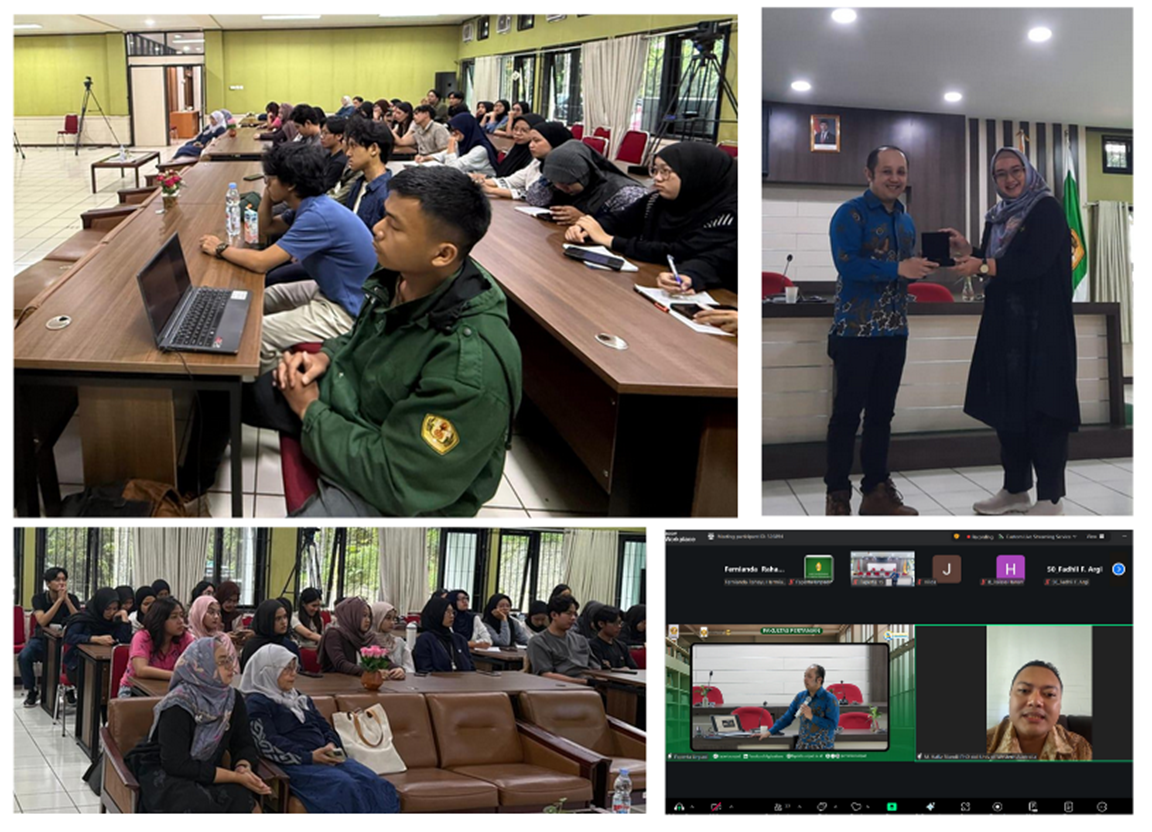
The guest lecture featured Dhanan Sarwo Utomo from Heriot-Watt University, Edinburgh Campus, United Kingdom, as the main speaker. In his presentation, he explained how a multi-agent systems approach can be applied to design more resilient transport and logistics systems capable of coping with disruptions, and uncertainty. This topic is highly relevant in the context of logistics and supply chain management, which is becoming increasingly complex and dynamic.
Kuliah tamu ini menghadirkan Dr. Dhanan Sarwo Utomo dari Heriot-Watt University, Edinburgh Campus, Inggris, sebagai narasumber utama. Dalam paparannya, pembicara menjelaskan bahwa, “Pendekatan multi-agent systems menjadi kunci dalam menghadapi tantangan logistik modern. Dengan sistem ini, setiap komponen dalam rantai pasok bertindak sebagai agen cerdas yang saling berkoordinasi untuk meminimalkan risiko kegagalan, sebuah solusi yang sangat relevan bagi pengelolaan logistik yang kian kompleks saat ini,” ungkapnya.
The activity was attended in person by 38 participants, consisting of 36 undergraduate students of the Agribusiness Program and 3 postgraduate students of the Agricultural Economics Master’s Program. Online participation comprised 94 participants, including 80 undergraduate students of the Agribusiness Program, 7 postgraduate students of the Agricultural Economics Master’s Program, and 8 international students from The University of Queensland, The University of Tokyo, Griffith University, Monash University, and The University of Western Australia. In addition, the guest lecture was also attended by representatives of the Faculty of Agriculture academic staff, including Prof. Dr. Tomy Perdana, S.P., M.M., Prof. Dr. Ir. Hj. Yosini Deliana, MS., Dr. Agriani Hermita Sadeli, and Dr. Sulistyodewi Nur Wiyono, SP., MP. This guest lecture is part of the enrichment of the material for the Agricultural Logistics Management and Supply Chain Engineering course in the Agribusiness Study Program, as well as the Agribusiness Supply Chain and Logistics Management, and Food Supply Chain and Logistics courses in the Master of Agricultural Economics Study Program, Faculty of Agriculture, Padjadjaran University.
This lecture activity is part of a series of competitive research programs implemented through a funding scheme provided by the Indonesian Endowment Fund for Education (LPDP) on behalf of the Ministry of Higher Education, Science, and Technology of the Republic of Indonesia, and managed under the EQUITY Program. The activity was carried out by a research team consisting of Prof. Dr. Tomy Perdana, S.P., M.M., Dr. Agriani Hermita Sadeli, S.P., M.E., and Dwi Novanda Sari, S.T.P., M.T. The title of the competitive research project is “Play-to-Change: Gamification of Urban Consumer Behavior Toward Food Consumption and Urban Food Waste Generation to Support the Transition to a Circular Supply Chain".
Through this activity, students gained additional insights that were not only theoretical but also practical, particularly regarding the application of intelligent systems and multi-agent approaches to enhance the resilience of transport and logistics systems. The session was conducted in an interactive atmosphere, with active participation from students through questions and direct discussions with the speaker. Many students reported gaining new perspectives on how multi-agent systems can support transport resilience and broaden their systems-thinking beyond conventional classroom materials.
Through this guest lecture, the Faculty of Agriculture, Unpad, reaffirms its commitment to delivering adaptive, contextual, and globally oriented learning, equipping students with competencies that are relevant to future challenges in logistics, and supply chain systems.
Through this initiative, the Faculty of Agriculture at Padjadjaran University (Faperta Unpad) reaffirms its commitment to providing adaptive, contextual, and globally-oriented learning to equip students with relevant competencies for future logistics and supply chain challenges. This international guest lecture directly contributes to the Sustainable Development Goals (SDGs) by supporting SDG 4 (Quality Education) through the provision of cutting-edge material and cross-border learning access, as well as SDG 9 (Industry, Innovation, and Infrastructure) by introducing multi-agent system technologies for transport resilience. Furthermore, its alignment with circular supply chain research and food waste reduction resonates with SDG 12 (Responsible Consumption and Production), while the collaboration with prestigious global universities strengthens SDG 17 (Partnerships for the Goals) in building a sustainable innovation ecosystem.
 English
  Indonesian