
Author: Syifa Djuita Putri
Jatinangor, April 17, 2026 — Bale Tatanen at Universitas Padjadjaran continues to strengthen its role as a field laboratory that integrates agriculture and technology in an applied setting. This open learning facility is designed not only as a practical training site but also as a modern agribusiness ecosystem that adapts to contemporary developments. Various production units are systematically developed, ranging from experimental plots to intensively managed greenhouses. This approach enables students and researchers to understand data-driven and efficiency-oriented agricultural practices. As such, Bale Tatanen serves as a contextual learning space that bridges theory and real-world implementation.
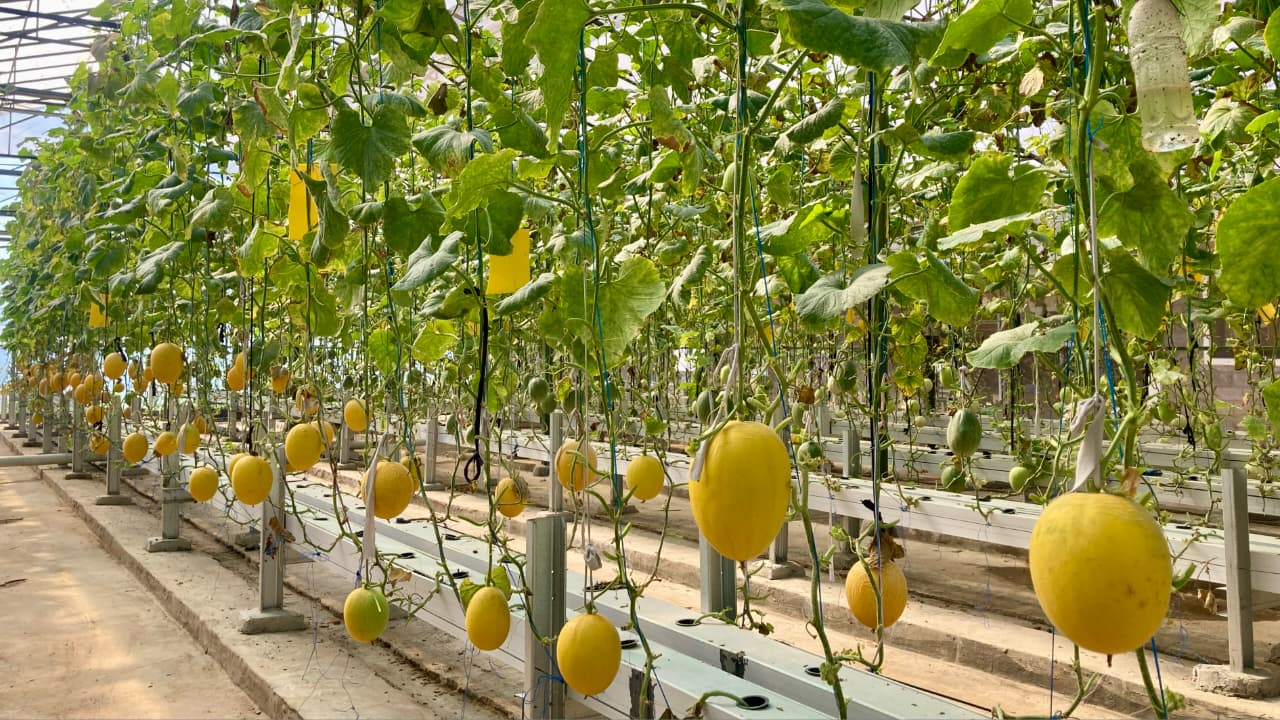
One of the flagship commodities currently gaining attention is hydroponic melon cultivation. This system functions not only as a learning medium but also as a model of modern farming that integrates technical and economic considerations simultaneously. Its management is conducted sustainably, with continuous evaluation to improve productivity and crop quality. The primary focus is placed on input efficiency and maintaining consistent product standards. This makes Bale Tatanen’s melon production a representative example of technology-based precision agriculture.
In practice, the hydroponic system applied combines the Deep Flow Technique (DFT) and the Machida method. The DFT approach focuses on producing a single fruit per plant through routine pruning of the main shoot to optimize nutrient allocation. In contrast, the Machida technique allows the development of up to three fruits per plant through a different canopy management strategy. The cultivation installation is divided into several rows, with rows 1–11 using the DFT system and rows 12–25 applying the Machida method. This arrangement provides a comparative framework to evaluate production outcomes and maintenance efficiency. The findings are expected to inform more optimal cultivation strategies in the future.
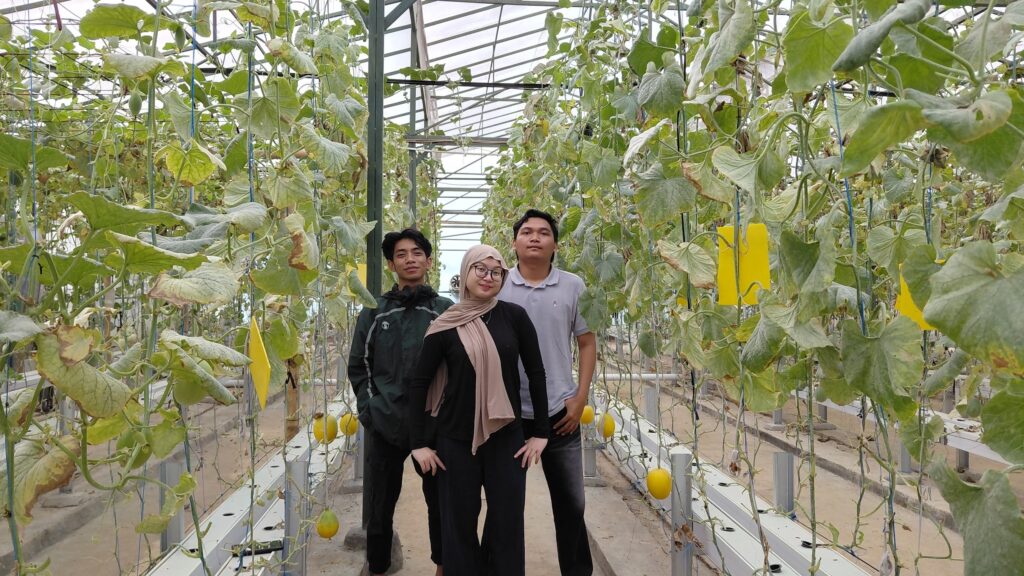
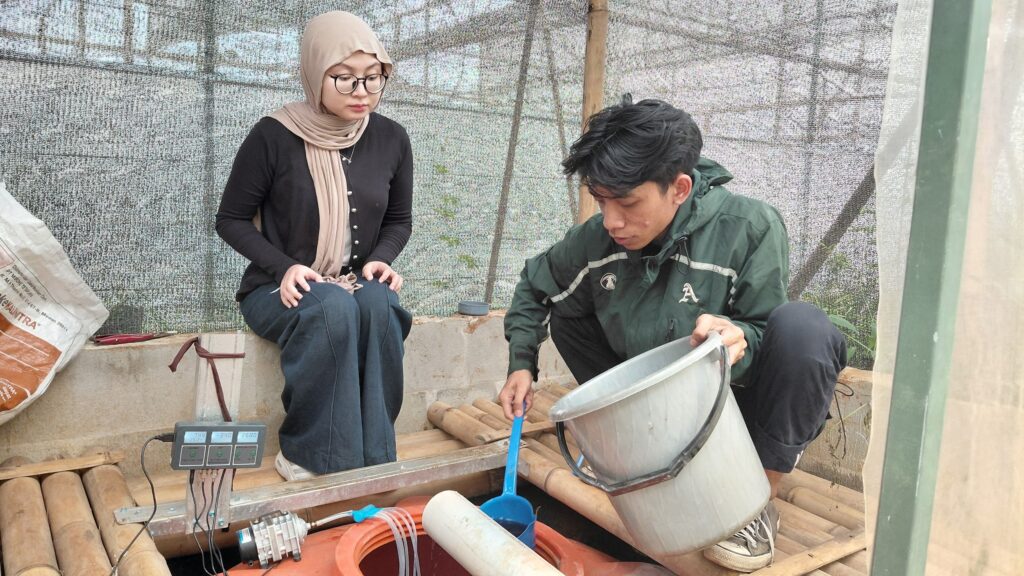
The greenhouse is managed through collaboration between the Faculty of Agriculture and PT Subur Indo Amerta, supported by skilled personnel. Students from the Faculty of Agricultural Industrial Technology (FTIP) are also actively involved, particularly in research and development activities. Among them are Refka Akbar Zahfara, Errens Joerdhi Fahrezi, and Salma Najwa Syakira, who contribute through both observation and hands-on technical work. Their involvement extends beyond data collection to direct participation in cultivation management. This synergy creates an applied, research-based learning environment. It also enhances students’ competencies in addressing challenges within modern agricultural industries.
From a technical perspective, four melon varieties are cultivated: Sweet Lavender, Sweet Honey, Honeydew, and Dalmatian. The selection is based on their adaptability to hydroponic systems, flavor characteristics, and market acceptance. All plants are maintained using AB mix nutrients, supplemented with additional elements as needed to address potential deficiencies. Crop maintenance is carried out intensively through daily pruning and leaf management to optimize nutrient distribution. Weed control is conducted mechanically, while routine monitoring is implemented to manage potential pest and disease outbreaks. These practices ensure both production stability and high-quality yields.
From an economic and sustainability standpoint, hydroponic melon cultivation at Bale Tatanen demonstrates strong potential. The resulting products are classified as premium, offering consistent taste, uniform appearance, and high levels of hygiene, which contribute to higher market value. Consumers can purchase the melons directly at the greenhouse while also experiencing on-site harvesting, fostering transparency in the supply chain. This model aligns with the Sustainable Development Goals, particularly SDG 12 (Responsible Consumption and Production) by promoting more conscious and efficient consumption patterns. It also contributes to SDG 8 (Decent Work and Economic Growth) through value creation in agribusiness. Furthermore, the integration of education, research, and field practice supports SDG 4 (Quality Education) while strengthening the internationalization and broader impact of the Faculty of Agriculture in advancing sustainable agriculture.
 English
  Indonesian