
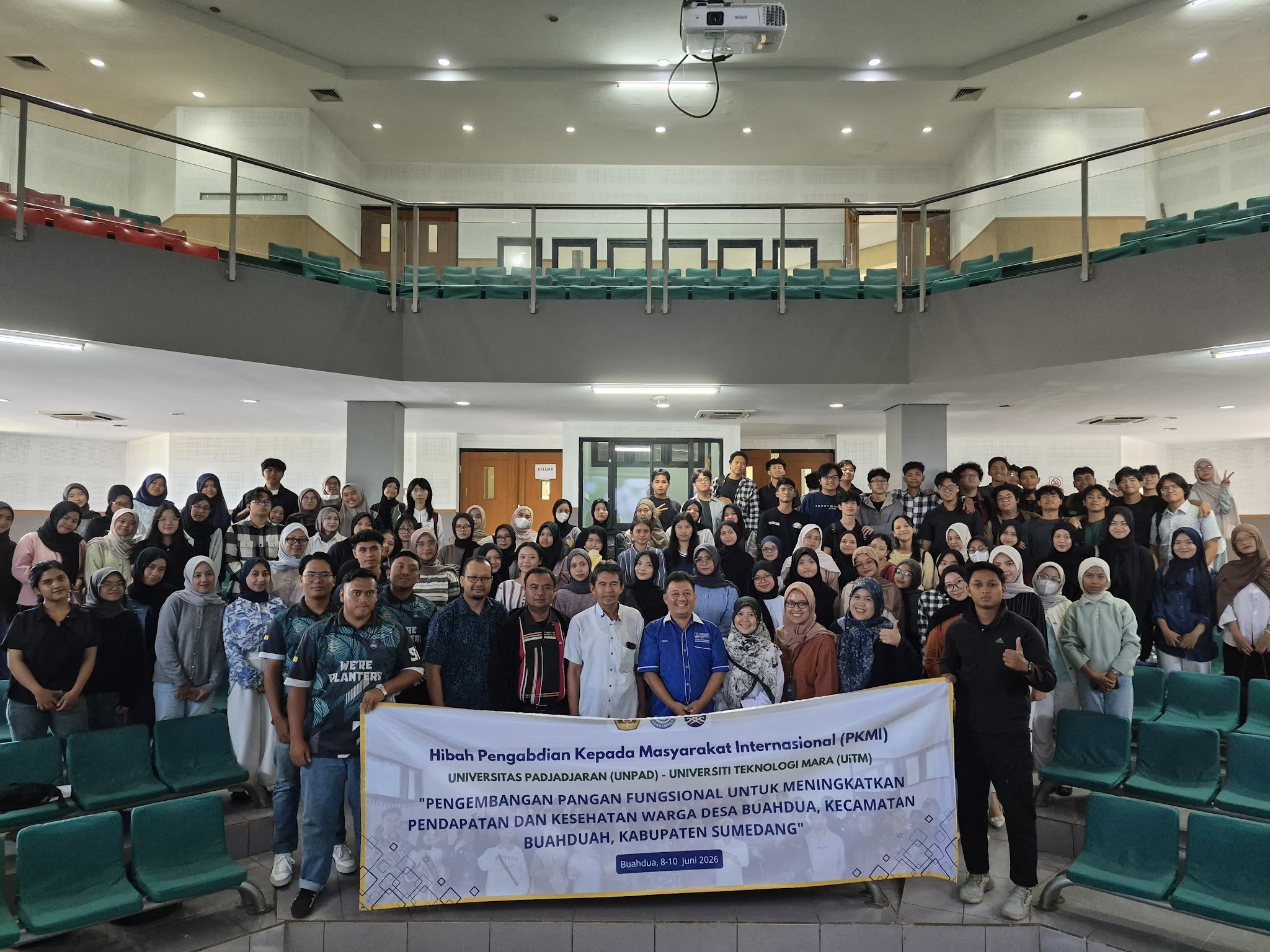
Unpad–UiTM International Collaboration Promotes Functional Food Crop Development for Farmers in Buahdua Village, Sumedang Regency
Author: Nuraini Fitri Aribah
Jatinangor, June 9, 2026 — The Faculty of Agriculture, Universitas Padjadjaran, has further strengthened its international academic network through the organization of a Visiting Lecture in collaboration with the Faculty of Plantation and Agrotechnology, Universiti Teknologi MARA (UiTM), Malaysia. Held at the Multimedia Building of the Faculty of Agriculture Unpad, the event featured two distinguished academics from UiTM, Dr. Mohammad Feizal Daud and Assoc. Prof. Dr. Alawi Sulaiman, accompanied by UiTM students.
The Visiting Lecture formed part of a long-standing international collaboration between the Faculty of Agriculture Unpad and UiTM Malaysia, which has been ongoing since 2023. Beyond facilitating academic knowledge exchange, the partnership also supports an international Community Service Program focused on the development of functional food crops for local communities.
The initiative was driven by challenges faced by farmers who have struggled to cultivate rice due to unfavorable environmental conditions, severe pest and disease infestations, and the relatively low economic value of rice compared to other crops. As an alternative, the community service team introduced functional food crops, namely Job’s tears (hanjeli) and black rice, which offer greater economic potential while also providing significant health benefits.
Through the program, farmers receive assistance in cultivation techniques, post-harvest processing, and the development of value-added functional food products derived from Job’s tears and black rice. This crop diversification strategy is expected to improve agricultural productivity while creating new opportunities to enhance farmers’ income and livelihoods.
During the Visiting Lecture, Dr. Mohammad Feizal Daud delivered a presentation entitled “Current Developments, Challenges, and Innovations in Food Crop Production and Management in Malaysia: An Agronomy Perspective.” The session provided insights into technological advancements, emerging challenges, and innovative approaches currently being implemented in Malaysia’s food crop production and management systems.
Meanwhile, Assoc. Prof. Dr. Alawi Sulaiman presented “Unlocking the Potential of Main Commodity Crops Agricultural Wastes: MAL-INDO Perspectives,” highlighting the utilization of agricultural residues as valuable resources. As part of the community service program, participants were also introduced to the conversion of crop residues into biochar, an innovation that supports more sustainable agricultural practices.
According to the organizers, the topics were selected to broaden students’ understanding of agricultural developments and innovations in Malaysia, enabling them to compare these experiences with conditions in Indonesia and identify potential approaches for advancing the national agricultural sector.
“We aim to provide students with a clearer picture of how food crop production and management are developing in Malaysia. We hope they can compare these experiences with the Indonesian context and gain inspiration for future agricultural development,” said Dr. Ir. Dwi Andreas Santosa, M.S., a representative of the collaboration team.
The issues discussed during the event are considered highly relevant to contemporary global challenges, particularly climate change and growing concerns over food security. According to Dr. Andreas, international cooperation plays a vital role in broadening perspectives and identifying practical solutions that can be adapted to local conditions.
“The world is currently facing major challenges related to climate change and food security. Therefore, knowledge-sharing initiatives such as this are essential, as they allow us to learn from one another and develop solutions that are relevant to the agricultural sectors of our respective countries,” he added.
Looking ahead, the partnership between the Faculty of Plantation and Agrotechnology UiTM Malaysia and the Faculty of Agriculture Unpad will extend beyond teaching and community service activities to include stronger international research collaboration.
“Our collaboration in education and community engagement has progressed well. Moving forward, we hope to strengthen international research partnerships through joint research grants involving academics from both institutions, thereby enhancing academic performance and scientific contributions at the global level,” he explained.
Through this cross-border academic and community engagement initiative, the Faculty of Agriculture Unpad and UiTM Malaysia reaffirm their shared commitment to advancing agricultural innovation that not only improves productivity but also promotes environmental sustainability and community well-being.
This collaboration is closely aligned with the United Nations Sustainable Development Goals (SDGs), particularly SDG 2 (Zero Hunger) through the promotion of food security and crop diversification, SDG 12 (Responsible Consumption and Production) through the valorization of agricultural waste into value-added products, and SDG 17 (Partnerships for the Goals) through the strengthening of international partnerships in education, research, and community service. It is hoped that this partnership will continue to grow and generate impactful innovations that contribute to agricultural advancement, improve farmers’ livelihoods, and support the development of a more resilient and sustainable food system in Indonesia and the broader region.
 English
  Indonesian