
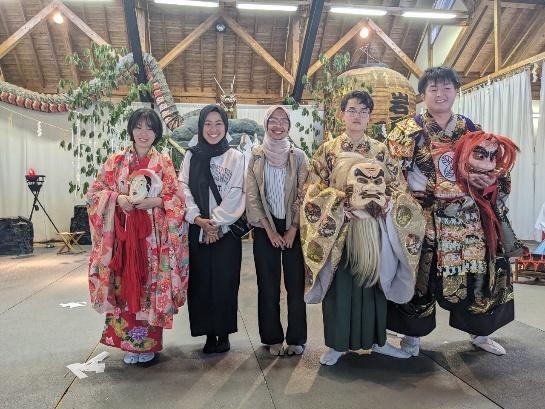
Two postgraduate students from the Faculty of Agriculture, Universitas Padjadjaran (Faperta Unpad), participated in the Visiting Research Program at Tokai University, Rinku Campus, Kumamoto, Japan, from August to September 2023. This program is part of the faculty’s efforts to strengthen academic internationalization and enhance students’ research capacity in a global environment.
The participating students were Febby Fitriyani (Doctoral Program in Agricultural Science) and Diyah Sri Utami (Master’s Program in Soil Science). During the program, both students conducted research in different laboratories according to their respective fields of study under the supervision of faculty members at Tokai University.
Febby Fitriyani carried out her research at the Laboratory of Natural Enemies and Environmental Entomology, focusing on soil fauna ecology, particularly the comparison of soil fauna communities between agricultural land and natural forest in the Kumamoto area. This research provides insights into the impact of land-use changes on soil biodiversity.
Meanwhile, Diyah Sri Utami conducted research in plant physiology and soil microbiology, focusing on plant responses to salinity stress and the role of microorganisms such as Vascular Arbuscular Mycorrhiza (VAM) and Rhizobium in enhancing plant resilience. The findings indicate that biological approaches have strong potential in supporting sustainable agriculture, particularly in saline-affected soils.
In addition to their research activities, both students actively participated in seminars, scientific discussions, and international academic forums, which broadened their knowledge and expanded their academic networks. This experience not only enhanced their technical and analytical skills but also strengthened academic collaboration between Universitas Padjadjaran and Tokai University.
This program is expected to serve as a foundation for broader international research collaboration, while also contributing to the advancement of education and research in sustainable agriculture.
 English
  Indonesian