Untitled-12

Agronomy

Double Degree – Agronomy

Agronomy

Master of agronomy is one of the graduate programs at the Faculty of Agriculture, Universitas Padjadjaran, which was founded on July 23, 1979, and was established based on the Decree of the Deputy Minister of Education, Teaching and Culture (ET&C) No. 85633/S, September 1, 1959. Master of Agronomy Study Program is the first study program (pioneer) at Universitas Padjadjaran. Master of Agronomy Study Program is accredited excellent according to the Badan Akreditasi Nasional Perguruan Tinggi (BAN-PT) No. 4919/SK/BAN-PT/Ak.KP/M/XI/2023.

Akreditasi Internasional ASIIN & Unggul BAN-PT

Kampus Jatinangor

Visi

Become a World Reputable Study Program in the field of Agronomy and have an Impact on Society by 2027.

Misi

  1. Organizing quality and accountable education to meet stakeholder demands.
  2. Carrying out research and community service for developing environmentally friendly agricultural science and technology (green agriculture) and increasing the competitiveness and welfare of business actors in the agricultural sector.
  3. Develop collaboration with various institutions, both domestic and foreign.
  4. Building the image of agriculture as a superior, competitive sector.

Objective

  1. To produce graduates with high-quality attitudes, integrity, and responsibility in applying the field of science, methodology, and scientific ethics based on the code of professional researchers.
  2. To produce graduates who are capable of developing knowledge, technology, and/or art in their field of expertise or professional practice through research, resulting in innovative and tested works.
  3. To produce graduates who are capable of solving scientific, technological, and/or artistic problems in their field through inter or multidisciplinary approaches.
  4. To produce graduates who are capable of managing research and development that is beneficial to society and the field of science, and able to gain national and international recognition.

Academic

Graduate Profile Number

Graduate Profile

Description

GP 1

Agronomy Specialist/ Expert

Serves as a professional consultant, manager, or entrepreneur in the field of agronomy.

GP 2

Principal Researcher/ Project Leader

Leads R&D projects in research institutions or private sector organizations.

GP 3

Lecturer/ Academia

Carries out the Tri Dharma of Higher Education (education, research, and community service).

GP 4

Policy Advisor

Provides evidence-based technical recommendations for policy formulation and implementation.

PLO Number

Program Learning Outcomes (PLO)

EQF Classification

(Level 7)

PLO 1

Exhibit a broad perspective, open-mindedness, positive thinking, and responsibility.

Responsibility and autonomy

PLO 2

Synthesize advanced knowledge and emerging issues in agronomy, including plant ecophysiology, weed science, plant breeding, and plant protection.

Knowledge

PLO 3

Formulate scientific approaches based on logical, critical, and systematic thinking to advance agronomic science and technology through research producing innovative and validated outcomes.

Skills

PLO 4

Enhance capacity for independent and collaborative lifelong learning.

Responsibility and autonomy

PLO 5

Articulate ideas effectively in oral and written forms and establish academic networks

Skills

PLO 6

Integrate knowledge and technologies in agronomy through interdisciplinary and multidisciplinary approaches.

Skills

PLO 7

Critically assess and resolve agronomic problems through interdisciplinary and multidisciplinary approaches.

Skills

PLO 8

Innovate and construct technological solutions to address agronomic challenges.

Skills

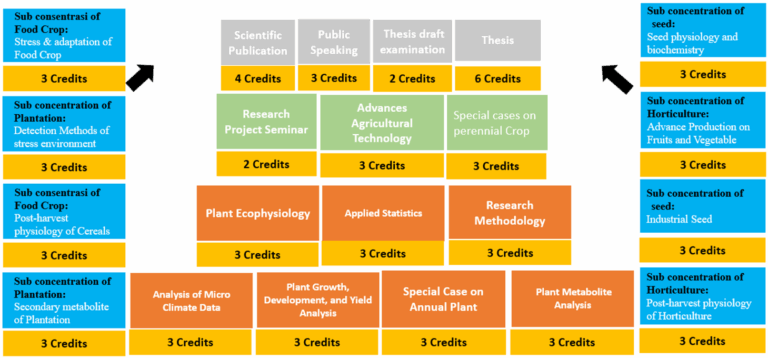
Specialization / Concentration: Ecophysiology

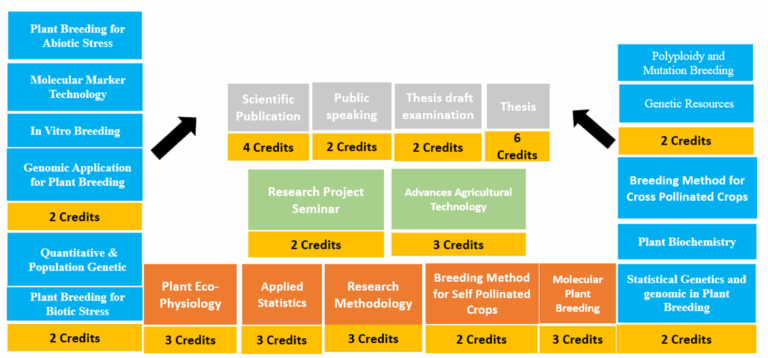
Specialization / Concentration: Plant Breeding

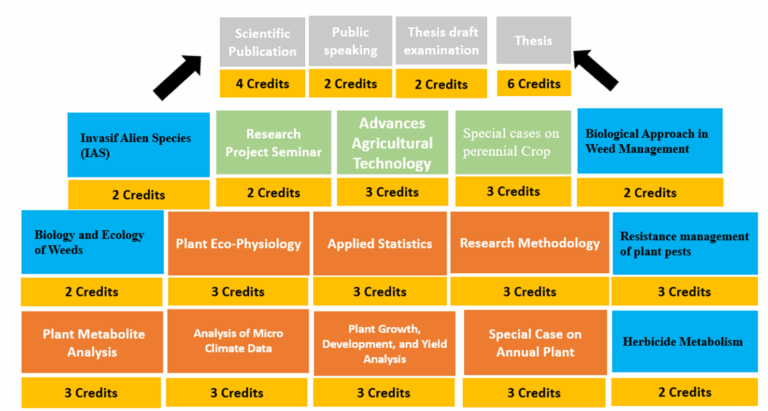
Specialization / Concentration: Weed Science

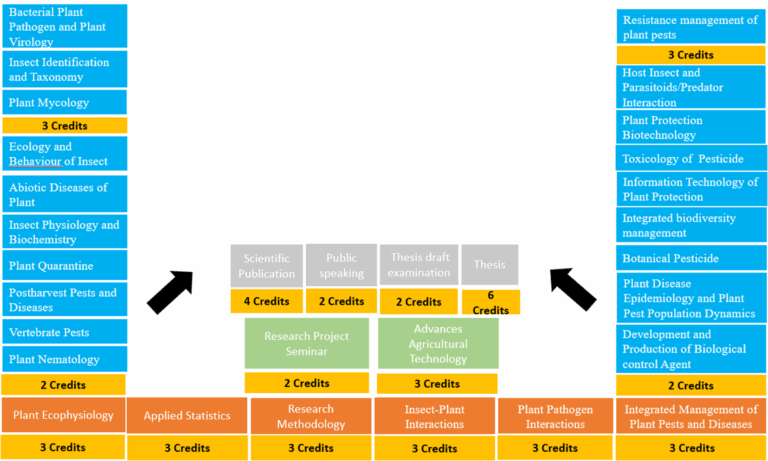
Specialization / Concentration: Plant Protection

Master by Project


Semester 1

CREDITS

Lecturer

1

Crop Genetics /Genetik Tanaman

4

Prof. Ir. Dedi Ruswandi, M.Sc., Ph.D.

Prof. Dr. rer. nat. Suseno Amien, Ir.

2

Genetic Selection Technique/ Teknik Seleksi Genetik

4

Prof. Ir. Dedi Ruswandi, M.Sc., Ph.D.

Prof. Dr. Warid Ali Qosim, Ir., M.S.

3

Rancangan riset untuk Pemuliaan tanaman (Field Experiment for Plant Breeding Purposive)

4

Dr. Ir. Meddy Rachmadi, M.S.

Noladhi Wicaksana, S.P., M.P., Ph.D.

4

Sumber daya genetik dan manajemen pemuliaan tanaman (Genetic Resources and Breeding Management)

4

Prof. Dr.Sc.agr. Ir. Agung K, M.Sc.Agr

Dr. Ade Ismail, S.P., M.P.


Semester 2

5

Breeding for Special Purposes (Practitioners)/ Teknik Khusus Pemuliaan untuk Praktisi

4

Dr. Dwi Asmono

Dr. Aziz Natawijaya

Dr. Ika Rostika Tambunan

Dr. I Made Mejaya

Assoc. Prof. Bibin Bintang Andriana (Kwansei Gakuin Univ, Japan)

Vergel Concibido, Ph.D. (Sensient, USA)

Assoc. Prof. Shaheed Ullah Khan, Ph.D. (South West Univ., Chong Qing , China)

Dr. Sri Koerniati

6

Academic Writing for Capstone Project/ Penulisan akademik untuk capstone project

4

Prof. Ir. Dedi Ruswandi, M.Sc., Ph.D.

Dr. Ade Ismail, S.P., M.P.

7

Proposal Capstone Project (Capstone Project Proposal)

2

Dr. Yudithia Maxiselly, SP., MP.

Prof. Dr. rer. nat. Suseno Amien, Ir.

8

Mata kuliah pilihan (Elective Course) (4 CREDITS)

4


Semester 3

9

Tugas Akhir (Capstone Project)

6

Prof. Dr.Sc.agr. Ir. Agung K, M.Sc.Agr; Prof. Dedi Ruswandi, Ir., M.Sc., Ph.D; Prof. Dr. rer.nat. Suseno Amien, Ir., Dr. Ade Ismail; Prof. Kusumiyati, Ir., M.Sc., Ph.D.

Total

36


Specialization / Concentration: Ecophysiology

Specialization / Concentration: Weed sciences

The compulsory subjects:

No

Subject

Credits

Semester

1

Applied Statistics

3

1

2

Plant Ecophysiology

3

1

3

Research Methodology

3

1

4

Plant Growth, Development and Yield Analysis

3

1

5

Plant Metabolite Analysis

3

1

6

Microclimate Management

3

1

7

Special Cases on Annual Crop

3

1

8

Research Proposal Seminar

2

2

9

Advanced Technology in Agriculture

3

2

10

Special Cases on Perennial Crop

3

2

11

Thesis draft examination

2

3

12

public speaking (community service/scientific seminar)

2

3

13

Scientific Publications

4

3

14

Thesis

6

3

Specialization / Concentration: Plant Breeding

The compulsory subjects:

No

Subject

Credits

Semester

1

Applied Statistics

3

1

2

Plant Ecophysiology

3

1

3

Research Methodology

3

1

4

Self-pollinating plant breeding methods

2

1

5

Molecular Plant Breeding

3

1

6

Research Proposal Seminar

2

2

7

Advanced Technology in Agriculture

3

2

8

Thesis draft examination

2

3

9

public speaking (community service/scientific seminar)

2

3

10

Scientific Publications

4

3

11

Thesis

6

3

The elective subjects:

No

Subject

Credits

Semester

1

Cross Pollinated Plant Breeding

2

1

2

Biotic Stress Breeding

2

1

3

Quantitative and Population Genetics

2

1

4

Genetic and Genomic Statistics in Plant Breeding

2

1

5

Plant Biochemistry

2

1

6

Genomic Applications for Plant Breeding

2

2

7

In-vitro breeding

2

2

8

Molecular Marking Technology

2

2

9

Plant Genetic Resources

2

2

10

Mutation Breeding and Polyploidy

2

2

11

Abiotic Stress Breeding

2

2

Specialization / Concentration: Plant Protection

The compulsory subjects:

No

Subject

Credits

Semester

1

Applied Statistics

3

1

2

Plant Ecophysiology

3

1

3

Research Methodology

3

1

4

Insect-Plant Interactions

3

1

5

Plant-Pathogen Interactions

3

1

6

Integrated Management of Plant Pests and Diseases

3

1

7

Research Proposal Seminar

2

2

8

Advanced Technology in Agriculture

3

2

12

Thesis draft examination

2

3

13

public speaking (community service/scientific seminar)

2

3

14

Scientific Publications

4

3

15

Thesis

6

3

The elective subjects:

No

Subject

Credits

Semester

1

Plant Nematology

2

1

2

Vertebrate Pests

2

1

3

Insect Identification and Taxonomy

3

1

4

Plant Mycology

3

1

5

Bacterial Plant Pathogen and Plant Virology

3

1

6

Postharvest Pests and Diseases

2

1

7

Plant Quarantine

2

1

8

Insect physiology and biochemistry

2

1

9

Plant Abiotic Diseases

2

1

10

Ecology and Pest Behavior

2

1

11

Development of biological control agents

3

2

12

Plant Disease Epidemiology and Plant Pest Population Dynamics

3

2

13

Botanicals pesticides

3

2

14

Integrated Biodiversity Management

3

2

15

Information Technology of Plant Protection

2

2

16

Toxicology of Pesticides

2

2

17

Pest, Pathogen and Weed Resistance Management

3

2

18

Plant Protection Biotechnology

2

2

19

Host Insect and Parasitoids-Predator Interaction

2

2

Research and Service

Student and Alumni

Instagram : kafpunpadku

Youtube : kafunpadku

Website : Karier Unpad