Untitled-12

Agribusiness

Bachelor's Degree – Agribusiness

Agribusiness

The Agribusiness Department at the Faculty of Agriculture, Universitas Padjadjaran, focuses on disruptive agribusiness. Agribusiness practices sharing and community-based collaboration within the triple, penta, and multiple helix model schemes. It transforms from corporate to inclusive, ecological, aesthetic, and Sharia-based communities. Adaptive and anticipative to the Industry 4.0 revolution and demographic bonus era. A series of courses are structured as project-based competency constructors (business planning, entrepreneurship, innovation, and agribusiness aesthetics, community development, research, and project development). Specifically, the Agribusiness Study Program delves into: (1) the fundamental characteristics of independence and entrepreneurship to build a mindset, spirit, and will; (2) agricultural science systems (agrosciences, biosciences), social systems and agricultural and rural ecosystems, agricultural production systems, and agricultural engineering (farming, agro-industry, institutions) to build practical agricultural capabilities (best practices); (3) agribusiness innovation ecosystems, agribusiness systems, economic and resource systems, sustainable agricultural and rural development systems, as well as community development methods to build market mapping capabilities, plan agribusiness entrepreneurship, create and innovate agribusiness, engineer supply chains, develop international agribusiness, and develop communities: regeneration of agricultural/rural technotalent; (4) digital applications in agribusiness, aesthetic applications (art, design, and architecture) in agribusiness: agribusiness information systems, agribusiness negotiation, and virtual agribusiness; and (5) application of analysis methods and tools for research and project development.

Akreditasi Internasional ASIIN & Unggul BAN-PT

Kampus Jatinangor

Visi

To become a leading international agribusiness study program in 2026 that produces highly competent and competitive graduates with the commitment to social, economics, environmental, and local cultural conditions.

Misi

  1. Implementing the teaching-learning process, research, and community service to produce professional scholars proficient in both hard and soft skills in designing, managing, and developing agribusiness enterprises.
  2. Providing opportunities and protection to farmers and small-scale entrepreneurs for a more prosperous and active involvement in sustainable agriculture, the industrialization of agricultural products, market modernization, and global agribusiness networks through research and community service activities.
  3. Making a tangible contribution to the development of science and technology to enhance the performance of the agribusiness system, thereby capable of providing prosperity to the farming communit.

Goals

  1. Able to think critically and innovatively in solving problems in the field of agricultural sciences
  2. Able to conduct research to develop science and technology that has novelty.
  3. Always increase self-capacity and competitiveness through a life-long learning process so as to gain national and international recognition.
  4. Contribute both directly and indirectly in efforts to improve the quality of life of the community (quality of life).
  5. Be ethical, responsible, have integrity and have a spirit of leadership.
 

Based on the aforementioned processes, the implementation of BAgb education is aimed to produce:

  1. Graduates who are qualified, competitive, and have high competence (knowledge, skills and attitudes) in applying science and technology;
  2. Graduates who are able to analyze agribusiness systems, economics and agricultural development and sociology of community development;
  3. Graduates who are able to compete globally;
  4. Graduates who can adapt new developments related to agribusiness with real-life problems, especially in providing production inputs, production, and farming of agricultural commodities, marketing and logistics, and agribusiness supporting institutions;
  5. Graduates who are able to develop careers, work efficiently both individually and in teams, possess leadership and managerial abilities.

Academic

Graduate Profile Number

Graduate Profile

Description

GP 1

Agribusiness Entrepreneur/ Startup Manager

Graduates are able to establish, manage, and scale agribusiness ventures across the value chain (from upstream to downstream) by applying entrepreneurial thinking and innovative business strategies.

GP 2

Agribusiness Enterprise Manager

Graduates are capable of planning, organizing, and supervising business operations in agricultural companies, cooperatives, agroindustries, or supply chain organizations, ensuring efficiency, sustainability, and competitiveness.

GP 3

Agribusiness and Marketing Consultant

Graduates can provide consultancy services to agribusiness firms by conducting market analysis, financial assessments, and business development planning, and by offering evidence based recommendations to support strategic decision making.

GP 4

Community Development Planner

Graduates are equipped to design, facilitate, and evaluate rural and agricultural community empowerment programs, focusing on entrepreneurship development, value chain strengthening, and sustainable livelihood interventions.

GP 5

Research Assistant/Data Analyst

Graduates are able to assist in planning and conducting agribusiness research using qualitative and quantitative methods, analyse data, prepare reports, and communicate scientific findings to support policy formulation, program planning, and business innovation.

PLO Number

Program Learning Outcomes (PLO)

EQF Classification (Level 6)

PLO 1

Demonstrate religious attitudes, tolerance, responsibility, and commitment to law, ethics, social norms, and environmental sustainability as lifelong learners.

Responsibility and autonomy

PLO 2

Explain and apply fundamental knowledge, current technologies, issues, and policies related to sustainable agribusiness systems, including input, production, marketing, processing, and supporting institutions

Knowledge

PLO 3

Apply and analyze crop production concepts, efficiency, feasibility, community development, and entrepreneurship to support strategic and operational decision-making in sustainable agribusiness.

Skills

PLO 4

Identify, and analyze problems, potentials, and prospects, and formulate alternative decisions in agribusiness networks using quantitative and qualitative approaches.

Skills

PLO 5

Design and implement innovative and environmentally sustainable agribusiness systems that create added value

Skills

PLO 6

Analyze problems in agribusiness subsystems and formulate solution strategies based on relevant data and information.

Skills

PLO 7

Plan and manage resources to support sustainable agribusiness operations.

Responsibility and autonomy

PLO 8

Apply and evaluate logical, critical, systematic, and innovative thinking in the application of science, technology, and humanities within agribusiness contexts

Skills

PLO 9

Collaborate and communicate effectively in multidisciplinary teams and develop professional networks

Responsibility and autonomy

PLO 10

Design and conduct research, analyze and interpret data, and produce scientifically sound reports in agribusiness studies

Skills

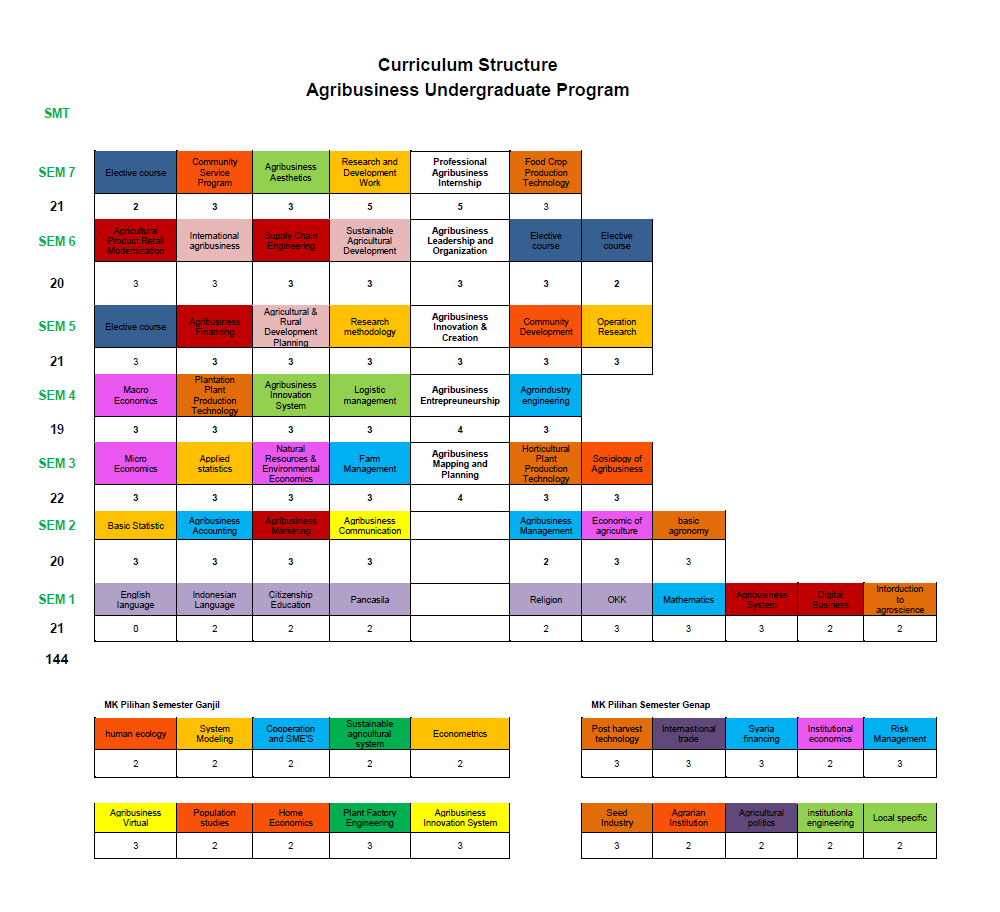
The compulsory subjects

  1. UNX01.007 – Pancasila
  2. UNX10.1016 – Religious Studies
  3. UNX01.004 – Bahasa Indonesia
  4. UNX01.008 – Civil Studies
  5. UNX01.006 – Creativity and Entrepreneurship
  6. E10F.144 – Agribusiness System
  7. E10F.179 – Introduction to Digital Agribusiness
  8. UNE10.102 – Mathematics
  9. E10E.1001 – Introduction to Agroscience
  10. E10E.292 – Basic Agronomy
  11. UNE10.203 – Basic Statistics
  12. E10F.204 – Agribusiness Marketing
  13. E10F.203 – Agribusiness Communications
  14. E10F.205 – Agribusiness Management
  15. E10F.240 – Agribusiness Accounting
  16. E10F.202 – Agricultural Economics
  17. E10F.293 – Food Crop Production Technology
  18. E10F.154 – Applied Statistics
  19. E10F.155 – Natural Resources and Environmental Economics
  20. E10F.156 – Farm Engineering
  21. E10F.157 – Agribusiness Enterprise Mapping and Planning (BEDP I)
  22. E10F.158 – Horticultural Crop Production Technology
  23. E10F.159 – Agribusiness Sociology
  24. E10F.160 – Microeconomics
  25. E10E.294 – Plantation Crop Production Technology
  26. E10F.260 – Agribusiness Innovation System
  27. E10F.261 – Logistics Management
  28. E10F.262 – Agribusiness Entrepreneurship (BEDP II)
  29. E10F.264 – Agroindustrial Engineering
  30. E10F.263 – Agribusiness Aesthetics
  31. E10F.266 – Macroeconomics
  32. E10F.161 – Agribusiness Finance
  33. E10F.162 – Agricultural and Rural Development Planning
  34. E10F.163 – Community Development
  35. E10F.164 – Operation Research
  36. E10F.165 – Agribusiness Creation and Innovation (BEDP III)
  37. E10F.178 – Research Methodology
  38. UNX10.108 – Community Service Program
  39. E10F.267 – Sustainable Agriculture Development
  40. E10F.268 – Agribusiness Leadership and Organization
  41. E10F.269 – Supply Chain Engineering
  42. E10F.270 – Agricultural Product Retail Modernization
  43. E10F.271 – International Agribusiness 
  44. E10F.177 – Professional Agribusiness Internship
  45. UNX10.211 – Thesis

Elective Courses

  1. Econometrics
  2. E10F.166 – System Modeling
  3. E10F.167 – Cooperation and SMEs
  4. E10F.168 – Quality Management
  5. E10F.169 – Population Studies
  6. E10F.170 – Home Economics
  7. E10F.171 – Virtual Agribusiness
  8. Sustainable Agriculture System
  9. E10F.172 – Agribusiness Information System
  10. Plant-Factory Engineering
  11. E10F.224 – Agrarian Institutions
  12. Institutional Economics
  13. E10F.272 – International Trade
  14. E10F.273 – Sharia Finance
  15. E10F.275 – Agricultural Politics
  16. E10E.2046 – Post-Harvest Engineering
  17. Seed Industry

Research and Service

Student and Alumni

Website Himpro Agri Unpad : Link

Instagram : himproagriunpad

Instagram : kafpunpadku

Youtube : kafunpadku

Website : Karier Unpad