-
Kampus Fakultas Pertanian Unpad, Jalan Raya Bandung-Sumedang km 21 Jatinangor Sumedang 45363

Graduates Profile
|
Graduate Profile Number |
Graduate Profile |
Description |
|
GP 1 |
Educator (Teacher/ Facilitator/ Community Developer) |
Graduates are competent in designing, implementing, and evaluating non-formal and informal education programs for diverse community groups. They serve as facilitators and catalysts in community empowerment, particularly in the dissemination and adoption of sustainable agricultural technologies. |
|
GP 2 |
Research Assistant |
Graduates are able to support principal researchers in identifying problems, planning and conducting research, and analyzing research results related to productive, effective, and efficient crop production technologies. They are also capable of communicating research findings effectively in both written and oral scientific formats. |
|
GP 3 |
Practitioner (Junior Bureaucrat/ Assistant Manager) |
Graduates are equipped to plan and manage land and crop production activities using up-to-date scientific knowledge and technological innovations in sustainable crop production. They are prepared to serve as junior officials in government institutions or assistant managers within agribusiness sectors. |
|
GP 4 |
Entrepreneur |
Graduates possess the ability to identify business opportunities, develop business plans, and establish sustainable crop production enterprises with strong economic and market-oriented perspectives. They are expected to become innovative agripreneurs contributing to the growth of sustainable agricultural industries |
Program Learning Outcome
PLO Number | Program Learning Outcomes (PLO) | EQF Classification (Level 6) |
PLO 1 | Demonstrate responsibility, self-confidence, ethical behavior, discipline, leadership, and commitment to lifelong learning, grounded in belief in One God. | Responsibility and autonomy |
PLO 2 | Apply fundamental concepts, current technologies, issues, and policies related to sustainable crop production systems and bio-based industries. | Knowledge |
PLO 3 | Apply methods and technologies to support sustainable crop production systems and analyze their advantages and constraints. | Skills |
PLO 4 | Apply and design biological and agro-ecological engineering to support sustainable agriculture and bio-based industrial systems based on relevant data and information analysis. | Skills |
PLO 5 | Identify crop production problems and formulate solution strategies based on analysis of relevant data and information. | Skills |
PLO 6 | Plan and manage resources to support sustainable agriculture. | Responsibility & Autonomy |
PLO 7 | Plan and apply research methodologies; document, analyze, and interpret data based on scientific procedures and ethics; and communicate results in theses, final projects, or scientific articles. | Skills |
PLO 8 | Work independently and in multidisciplinary teams and develop professional networks. | Responsibility & Autonomy |
PLO 9 | Demonstrate logical, critical, and systematic thinking and communicate effectively in oral and written forms in accordance with scientific ethics. | Skills |
Curriculum
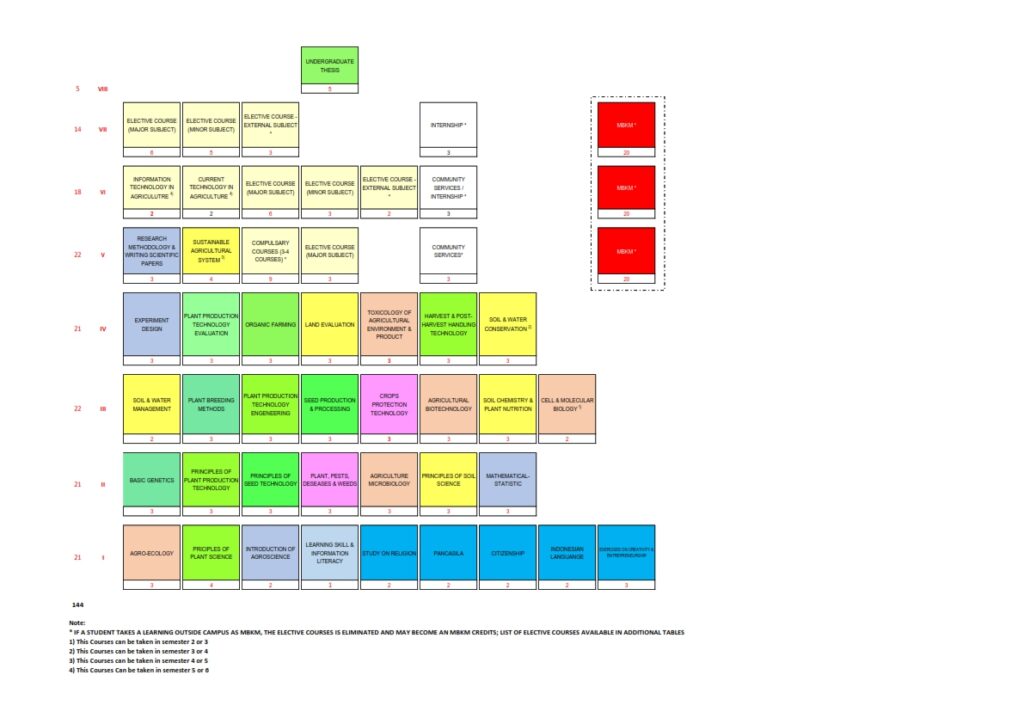
NO | COURSE CODE | COURSE | CREDITS | ECTS |
1st Semester | ||||
1 | Religious Studies | 2 | 2.4 | |
2 | Pancasila | 2 | 2.4 | |
3 | Civil Studies | 2 | 2.4 | |
4 | Bahasa Indonesia | 2 | 2.4 | |
5 | English | 2 | 2.4 | |
6 | Cultivate Creativity and Entrepreneurship | 3 | 3.6 | |
7 | Agroscience Introduction | 2 | 2.4 | |
8 | Fundamentals of Plant Science | 4 | 4.8 | |
9 | Agroecology | 3 | 3.6 | |
10 | KBLI | 1 | 1.2 | |
SUM | 23 | 27.6 | ||
2nd Semester | ||||
1 | Mathematics and Statistics | 3 | 3.6 | |
2 | Cell and Molecular Biology | 2 | 2.4 | |
3 | Fundamentals of Soil Science | 3 | 3.6 | |
4 | Fundamentals of Seed Technology | 3 | 3.6 | |
5 | Fundamentals of Plant Production Technology | 3 | 3.6 | |
6 | Fundamentals of Genetics | 3 | 3.6 | |
7 | Agricultural Microbiology | 3 | 3.6 | |
8 | Plant Pest and Disease | 3 | 3.6 | |
SUM | 23 | 27.6 | ||
3rd Semester | ||||
1 | Soil and Water Conservation | 3 | 3.6 | |
2 | Agricultural Biotechnology | 3 | 3.6 | |
3 | Water and Soil Management | 3 | 3.6 | |
4 | Plant Breeding Methods | 3 | 3.6 | |
5 | Soil Chemistry and Plant Nutrition | 3 | 3.6 | |
6 | Seed Production and Management | 3 | 3.6 | |
7 | Plant Production Technology Engineering | 3 | 3.6 | |
8 | Plant Protection Technology | 3 | 3.6 | |
SUM | 24 | 28.8 | ||
4th Semester | ||||
1 | Experimental Design | 3 | 3.6 | |
2 | Land Evaluation | 3 | 3.6 | |
3 | Plant Production Technology Evaluation | 3 | 3.6 | |
4 | Harvest and Post-Harvest Management | 3 | 3.6 | |
5 | Environmental Toxicology and Agricultural Products | 3 | 3.6 | |
6 | Organic Agriculture System | 3 | 3.6 | |
7 | Sustainable Agriculture System | 4 | 4.8 | |
SUM | 22 | 26.4 | ||
5th Semester | ||||
1 | Information Technology in Agriculture | 2 | 2.4 | |
2 | Current Technology in Agriculture | 3 | 3.6 | |
3 | MIPKI | 3 | 3.6 | |
4 | KKNM | 3 | 3.6 | |
5 | Interdisciplinary Course (1 Subject) | 3 | 3.6 | |
6 | Elective Course (3 Subjects) | 3 | 3.6 | |
SUM | 17 | 20.4 | ||
6th Semester | ||||
1 | Elective Courses or Activity-Based Courses | 20 | 24 | |
SUM | 20 | 24 | ||
7th Semester | ||||
1 | Cross-Disciplinary Course (Agribusiness) | 6 | 7.2 | |
2 | Thesis | 5 | 6 | |
SUM | 11 | 13.2 | ||
Department of Plant Breeding Elective Courses | ||||
1 | Plant Genetic Resources | 2 | 2.4 | |
2 | Plant Breeding Management | 2 | 2.4 | |
3 | Molecular Plant Breeding | 3 | 3.6 | |
4 | Mutation Plant Breeding | 2 | 2.4 | |
5 | Plant Breeding Program Design | 2 | 2.4 | |
6 | Fundamentals of Quantitative Genetics | 2 | 2.4 | |
7 | Field and Laboratory Skills in Plant Breeding | 3 | 3.6 | |
8 | Participatory Plant Breeding | 2 | 2.4 | |
Department of Plant Production Elective Courses | ||||
1 | Rice and Maize Crop Production | 3 | 3.6 | |
2 | Alternative Food Crop Production | 3 | 3.6 | |
3 | Legume and Tuber Crop Production | 3 | 3.6 | |
4 | Management of Food Crop Production | 3 | 3.6 | |
5 | Double Cropping System | 2 | 2.4 | |
6 | Vegetable Crop Production | 3 | 3.6 | |
7 | Ornamental Plant Production | 3 | 3.6 | |
8 | Management and Quality Control of Horticultural Products | 3 | 3.6 | |
9 | Fruit Crop Production | 3 | 3.6 | |
10 | Hydroponics | 3 | 3.6 | |
11 | Plantation Crop Production for Refreshments | 3 | 3.6 | |
12 | Plantation Crop Production for Sugar and Medicinal Purposes | 3 | 3.6 | |
13 | Plantation Crop Production for Latex and Oil | 3 | 3.6 | |
14 | Management of Plantation Crop Production | 3 | 3.6 | |
15 | Plant Micropropagation Technology | 3 | 3.6 | |
16 | Production and Management of Recalcitrant Plant Seeds | 3 | 3.6 | |
17 | Vegetative Propagation | 3 | 3.6 | |
18 | Herbicide | 3 | 3.6 | |
19 | Specialized Weed Control Techniques | 3 | 3.6 | |
20 | Weed Control Management | 3 | 3.6 | |
Department of Soil Science and Land Resource Management Elective Courses | ||||
1 | Watershed Management | 3 | 3.6 | |
2 | Soil Quality | 3 | 3.6 | |
3 | Regional Planning and Land Use Development | 3 | 3.6 | |
4 | Fertilizer Technology and Fertilization | 3 | 3.6 | |
5 | Image and Geographic Information Systems (GIS) Interpretation | 3 | 3.6 | |
6 | Landscape Analysis | 3 | 3.6 | |
7 | Growing Media Technology | 3 | 3.6 | |
8 | Biofertilization | 3 | 3.6 | |
Department of Plant Pest and Disease Elective Courses | ||||
1 | Pesticides and Application Techniques | 3 | 3.6 | |
2 | Special Laboratory and Field Skills | 3 | 3.6 | |
3 | Observation System – Pest and Disease Forecasting for Plants | 3 | 3.6 | |
4 | Food Crop Protection | 3 | 3.6 | |
5 | Vegetable Crop Protection | 3 | 3.6 | |
6 | Beneficial and Profitable Insects | 3 | 3.6 | |
7 | Urban Pest | 3 | 3.6 | |
8 | Natural Pesticides | 3 | 3.6 | |
9 | Fruit and Ornamental Plant Protection | 3 | 3.6 | |
10 | Plantation Crop Protection | 3 | 3.6 | |
11 | Agricultural Quarantine | 3 | 3.6 | |
Cross-Disciplinary Courses | ||||
1 | Agribusiness Management | 3 | 3.6 | |
2 | Financing and Banking | 3 | 3.6 | |
Modul Handbook
The compulsory subjects
- UNX01.007 – Pancasila
- UNX10.1016 – Religion Studies
- UNX01.004 – Indonesian Language
- UNX01.008 – Civic
- UNX01.006 – Cultivate Creativity and Entrepreneurship
- E10E.1001 – Introduction to Agroscience
- Fundamentals of Plant Science
- Agroecology
- KBLI
- Mathematics and Statistics
- Cell and Molecular Biology
- Fundamentals of Soil Science
- Fundamentals of Seed Technology
- Fundamentals of Plant Production Technology
- Fundamentals of Genetics
- Agricultural Microbiology
- Plant Pest and Disease
- Soil and Water Conservation
- Agricultural Biotechnology
- Water and Soil Management
- Plant Breeding Methods
- Soil Chemistry and Plant Nutrition
- Seed Production and Management
- Plant Production Technology Engineering
- Plant Protection Technology
- Experimental Design
- Land Evaluation
- Plant Production Technology Evaluation
- Harvest and Post-Harvest Management
- Environmental Toxicology and Agricultural Products
- Organic Agriculture System
- Sustainable Agriculture System
- Information Technology in Agriculture
- Current Technology in Agriculture
- MIPKI
- Community Service Program
Department of Plant Breeding Elective Courses
- Plant Genetic Resources
- Plant Breeding Management
- Molecular Plant Breeding
- Mutation Plant Breeding
- Plant Breeding Program Design
- Fundamentals of Quantitative Genetics
- Field and Laboratory Skills in Plant Breeding
- Participatory Plant Breeding
Department of Plant Production Elective Courses
- Rice and Maize Crop Production
- Alternative Food Crop Production
- Legume and Tuber Crop Production
- Management of Food Crop Production
- Double Cropping System
- Vegetable Crop Production
- Ornamental Plant Production
- Management and Quality Control of Horticultural Products
- Fruit Crop Production
- Hydroponics
- Plantation Crop Production for Refreshments
- Plantation Crop Production for Sugar and Medicinal Purposes
- Plantation Crop Production for Latex and Oil
- Management of Plantation Crop Production
- Plant Micropropagation Technology
- Production and Management of Recalcitrant Plant Seeds
- Vegetative Propagation
- Herbicide
- Specialized Weed Control Techniques
- Weed Control Management
Department of Plant Pest and Disease Elective Courses
- Pesticides and Application Techniques
- Special Laboratory and Field Skills
- Observation System – Pest and Disease Forecasting for Plants
- Food Crop Protection
- Vegetable Crop Protection
- Beneficial and Profitable Insects
- Urban Pest
- Natural Pesticides
- Fruit and Ornamental Plant Protection
- Plantation Crop Protection
- Agricultural Quarantine
Department of Soil Science and Land Resource Management Elective Courses
- Watershed Management
- Soil Quality
- Regional Planning and Land Use Development
- Fertilizer Technology and Fertilization
- Image and Geographic
- Information Systems (GIS) Interpretation
- Landscape Analysis
- Growing Media Technology
- Biofertilization
Cross-Disciplinary Courses
- Agribusiness Management
- Financing and Banking
Agrotechnology
 Indonesian
  English